
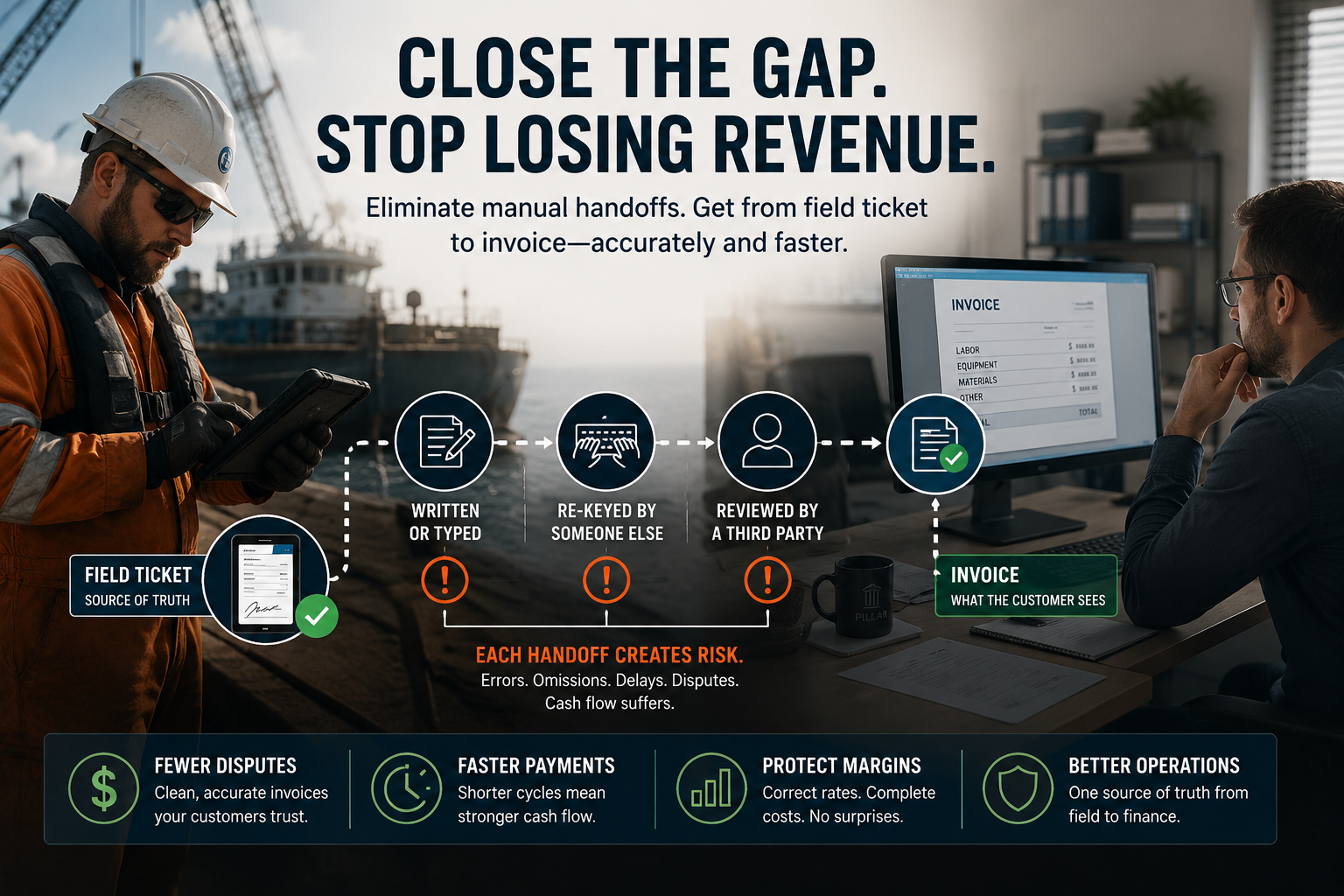
Somewhere between the field and the billing office, hours get lost. Materials get forgotten. Markups get misapplied. And by the time the customer receives an invoice, the numbers don't match what your crew actually recorded on-site.
This is one of the most common revenue leaks in time-and-materials work, and it quietly drains cash from marine operators, industrial contractors, and construction firms every single billing cycle.
The field ticket is the source of truth. But in most operations, it travels a slow, manual road — handwritten or typed somewhere, then re-keyed by someone else, then reviewed by a third person who wasn't there. Each handoff is a chance for a number to shift, a line item to disappear, or a rate to be applied incorrectly.
When the invoice lands and the customer disputes it, the clock stops. Payment pauses. Your team scrambles to reconcile documents from two weeks ago. That's not a billing problem. That's a cash flow problem dressed up as a paperwork problem.
The fix isn't complicated in concept. If the data captured in the field flows directly into the invoice without being re-entered by human hands, the gaps close. What the crew recorded is what the customer sees. Disputes shrink. Payment cycles shorten. Margin becomes measurable instead of mysterious.
That's good operations. And good operations make the business easier to run, easier to scale, and easier to trust — whether you're managing one crew or forty.
Try this: Picture your last disputed invoice. Trace it back to the original field ticket. Count how many times that information was touched, typed, or transferred by a different person before it reached the customer. That gap is your problem — and now you can see exactly where it lives.
By Ross Armstrong, Co-Founder, Pillar Optimization Partners
Co-Founder of Pillar Optimization Partners, building efficient financial and operations automations for Gulf South industrial contractors and marine operators.