
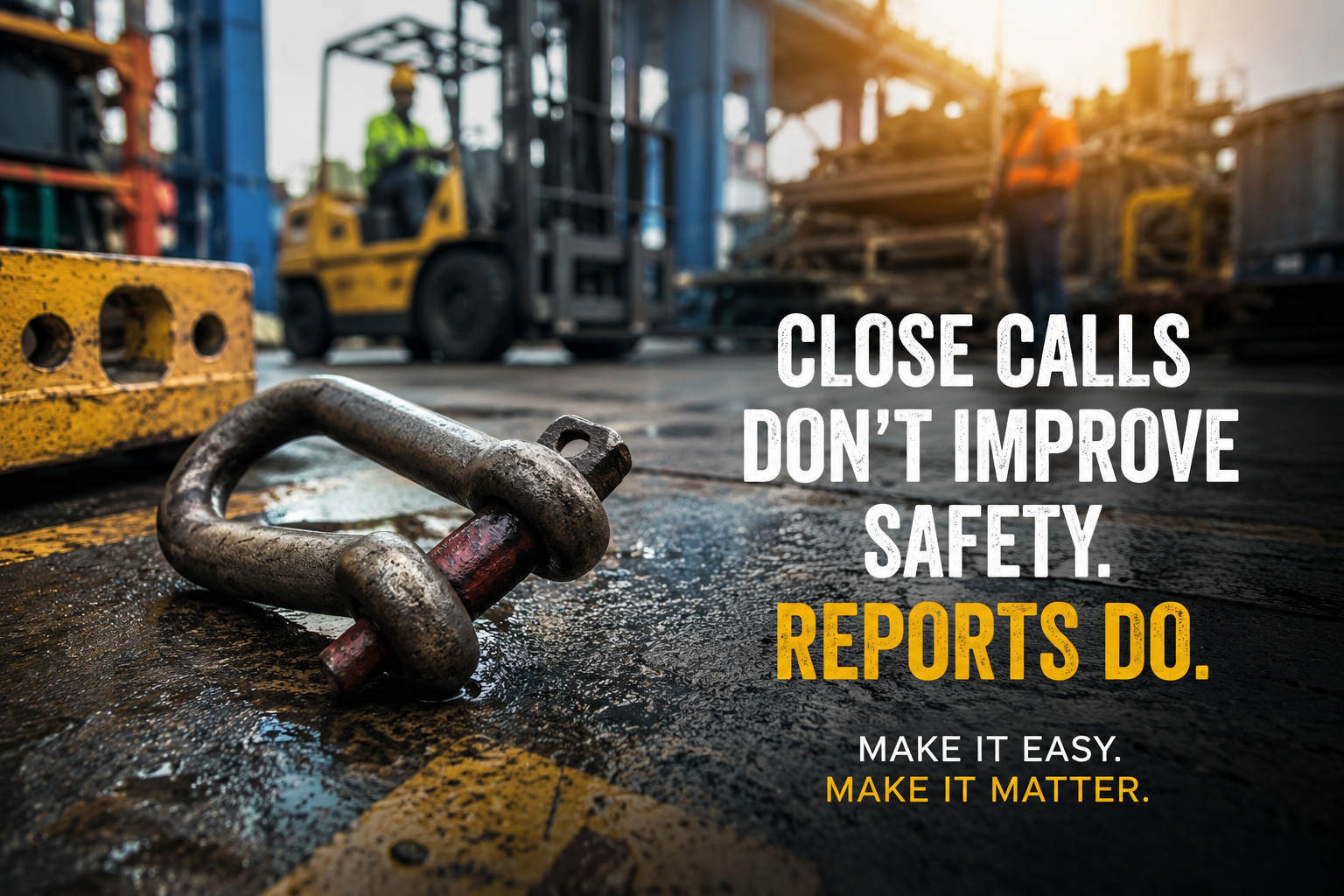
Someone almost got hurt yesterday.
Maybe it was a dropped shackle on the deck. Maybe a forklift cut a corner too close in the fab yard. Maybe someone cracked open a valve that should have stayed closed.
Nobody was injured.
Everyone went back to work.
Nobody wrote it down.
That’s how risk accumulates.
Not through the incidents that make it into the safety report, but through the dozens of close calls that disappear before the next shift begins. A quick conversation. A shrug. A mental note to “be more careful next time.” Then the day moves on, and the opportunity to learn from it disappears.
Most companies don’t lack people who care about safety.
They lack a process that makes reporting frictionless.
When reporting a near-miss means tracking down a supervisor, finding the right form, filling out paperwork, or waiting until the end of a twelve-hour shift, the report usually never gets written. Not because people don’t care, but because the work always comes first.
This isn’t a culture problem.
It’s a friction problem.
The solution isn’t another safety meeting or another reminder posted on the bulletin board.
The solution is removing the friction.
When a crew member can report a near-miss in less than a minute—from a phone, a tablet, or a kiosk near the jobsite—the information gets captured while it’s still fresh. The location, the equipment involved, the people nearby, and what almost happened are recorded before memory fades or the next task takes over.
Then something powerful happens.
Instead of isolated stories, leadership begins to see patterns.
The same blind corner in the yard.
The same lift being used incorrectly.
The same piece of equipment involved over and over.
The same shift where incidents keep occurring.
Patterns reveal problems long before accidents do.
That’s when safety changes from being reactive to being predictive.
And that’s where the real return comes from.
Preventing one serious injury protects your people. It also protects your EMR, reduces downtime, lowers insurance costs, preserves customer confidence, and safeguards the contracts you’ve worked years to earn. The cost of preventing an incident is almost always a fraction of the cost of responding to one.
Here’s a simple exercise.
Tomorrow, during shift change, listen for someone to mention a close call from earlier in the day.
Then follow that information.
Does it become a documented report that leadership can learn from?
Or does it disappear into the conversation?
If the answer is the latter, your biggest safety risk may not be what happened.
It may be what never gets reported.
⸻
By Ross Armstrong, Co-Founder, Pillar Optimization Partners
Pillar helps industrial contractors, marine operators, and construction companies eliminate operational bottlenecks through intelligent automation, practical workflows, and systems that improve safety, cash flow, and operational visibility.